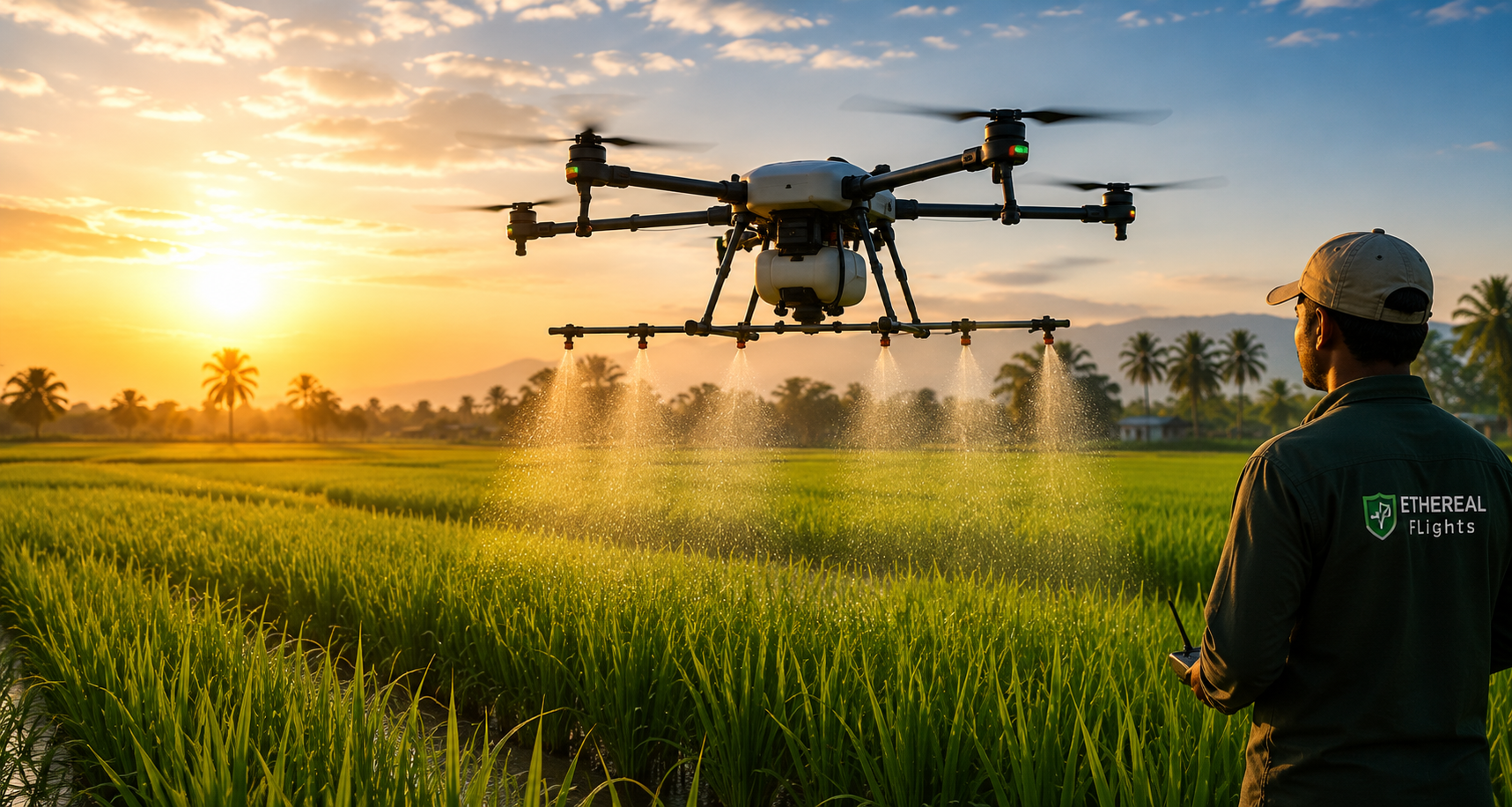
Walk through a kharif paddy field in September and you will see why spraying is the job farmers dread most: drums hauled to the bund, a labourer wading through a closed canopy with a leaking knapsack, and valuable spray windows lost to labour shortages, water logistics and weather. Ethereal Flights changes that equation with precision agricultural drone solutions built for Indian conditions — from crop monitoring and precision spraying to Drone-as-a Service deployments for farmers, FPOs, agri input companies and institutions.
1. Around 90% less water per acre
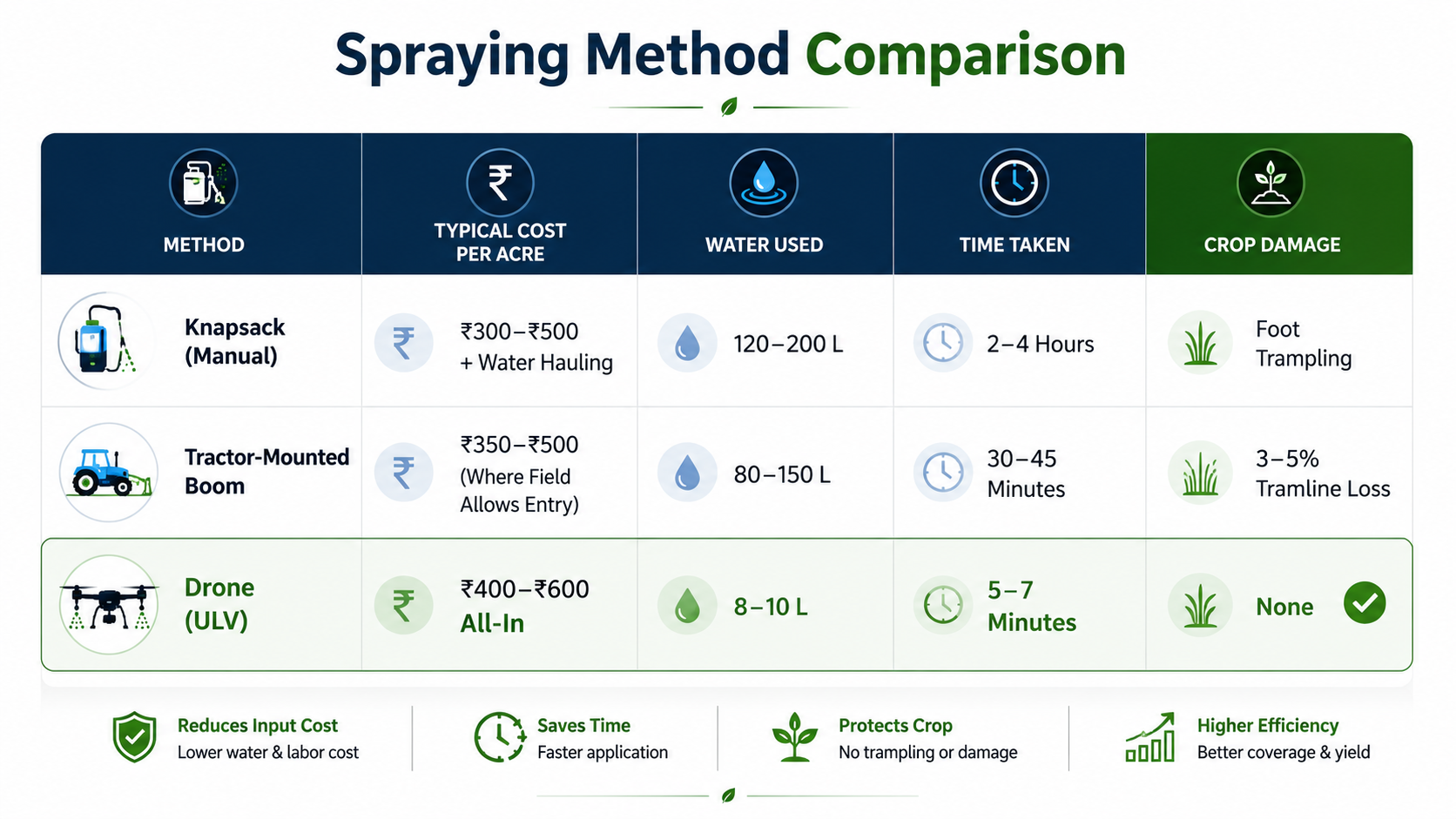
A drone applies pesticide as an ultra-low-volume (ULV) mist of roughly 8-10 litres of spray fluid per acre, against 120-200 litres for a knapsack crew — a saving of around 90%. In the borewell dependent uplands of Telangana or the rain-shadow blocks of Marathwada, that is the difference between spraying a rabi jowar or gram crop the day a pest crosses threshold and waiting until water can be arranged. It also deletes the drum logistics: no ferrying barrels to a plot two kilometres from the nearest pipe, no second labourer just to fetch and mix.
2. Faster spray windows, better pest control
A 10-litre agri drone covers an acre in about 5-7 minutes and 25-30 acres in a working day. A labourer with a knapsack manages roughly 1-1.5 acres a day. That 20-30x speed difference is not a convenience — it is pest control. When brown planthopper flares in Krishna-delta paddy or pink bollworm crosses the economic threshold in cotton, the spray only works if the whole field is treated inside a narrow window. Drones make same-day, whole-farm treatment realistic for the first time, and at peak kharif — when spray labour is scarce in much of Telangana and Vidarbha at any wage — speed doubles as availability.
3. Far less chemical exposure for people
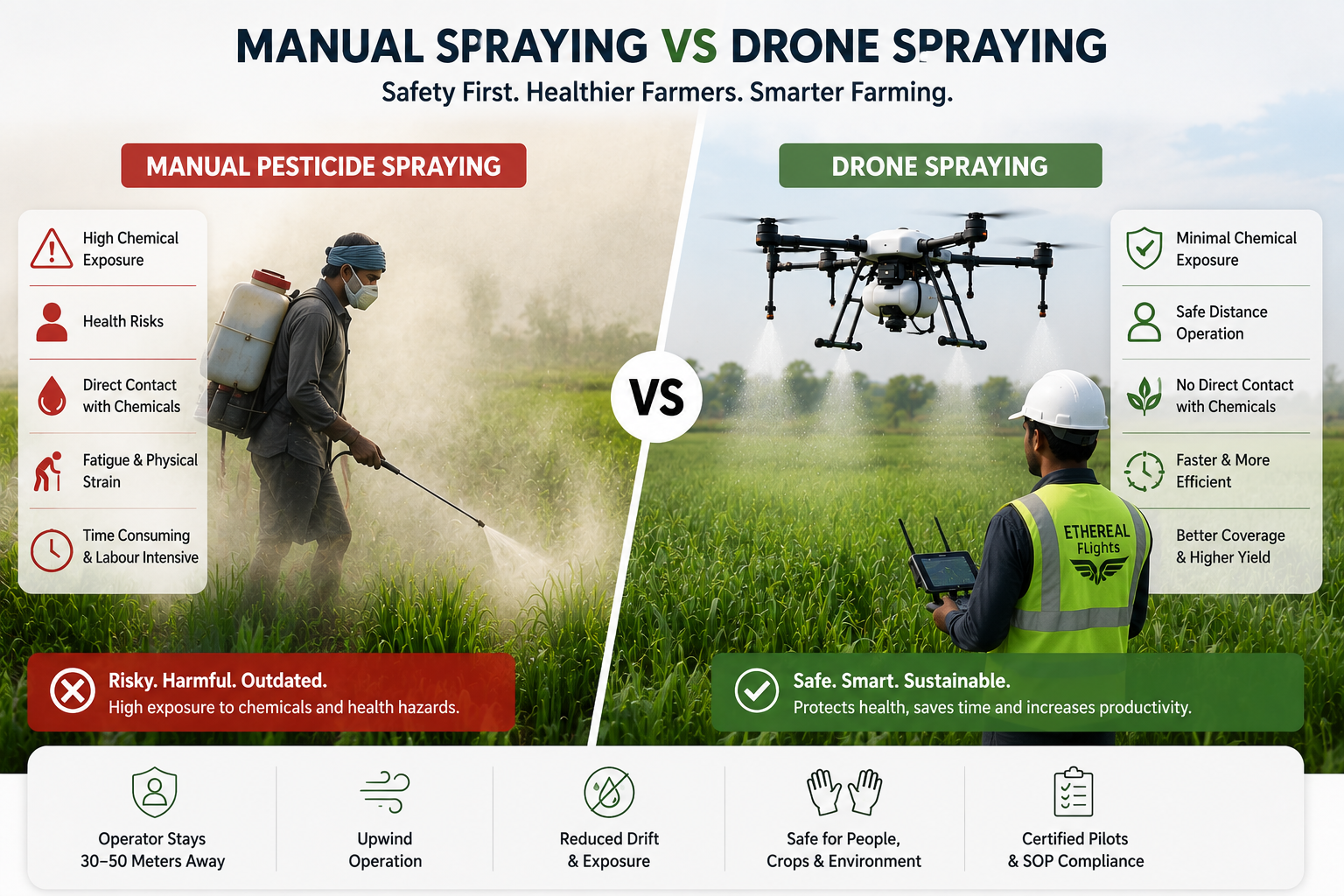
With a knapsack, the person spraying walks inside the spray cloud for hours, often without full PPE, with a tank against the back that frequently leaks. With a drone, the pilot stands 30-50 metres away, upwind, and never touches the crop during application. For the more hazardous label categories, that physical separation is the single biggest occupational-safety upgrade available to Indian farm labour today. Certified pilots additionally follow CIB&RC label SOPs — approved chemistries at label dosages, PPE during mixing, and buffer distances near waterbodies and habitation.
4. Uniform, fine-droplet coverage
Agri drones deliver droplets in roughly the 50-300 micron range, and the downwash from the rotors drives that fine mist into the canopy — including the underside of leaves, where whitefly, thrips and mites actually sit. Terrain-following sensors hold the drone at a constant 2-3 metres above the crop, so swath width and deposition stay uniform across the field instead of varying with a tired labourer's walking speed and pump rhythm. The practical result is fewer missed strips and fewer 'why is one corner still infested' repeat sprays.
5. Zero crop trampling
Every pass of a tractor-mounted boom, and every labourer walking through standing crop, flattens plants. With ground equipment, tramlines and foot traffic typically cost 3-5% of yield — plants that were grown, irrigated and fertilised, then crushed at the final step. A drone touches nothing. In a closed-canopy paddy field, a flowering redgram stand or a bed-planted Guntur chilli crop, that avoided damage alone can be worth more than the spraying fee itself.
6. Better timing: dawn, dusk and low-wind windows
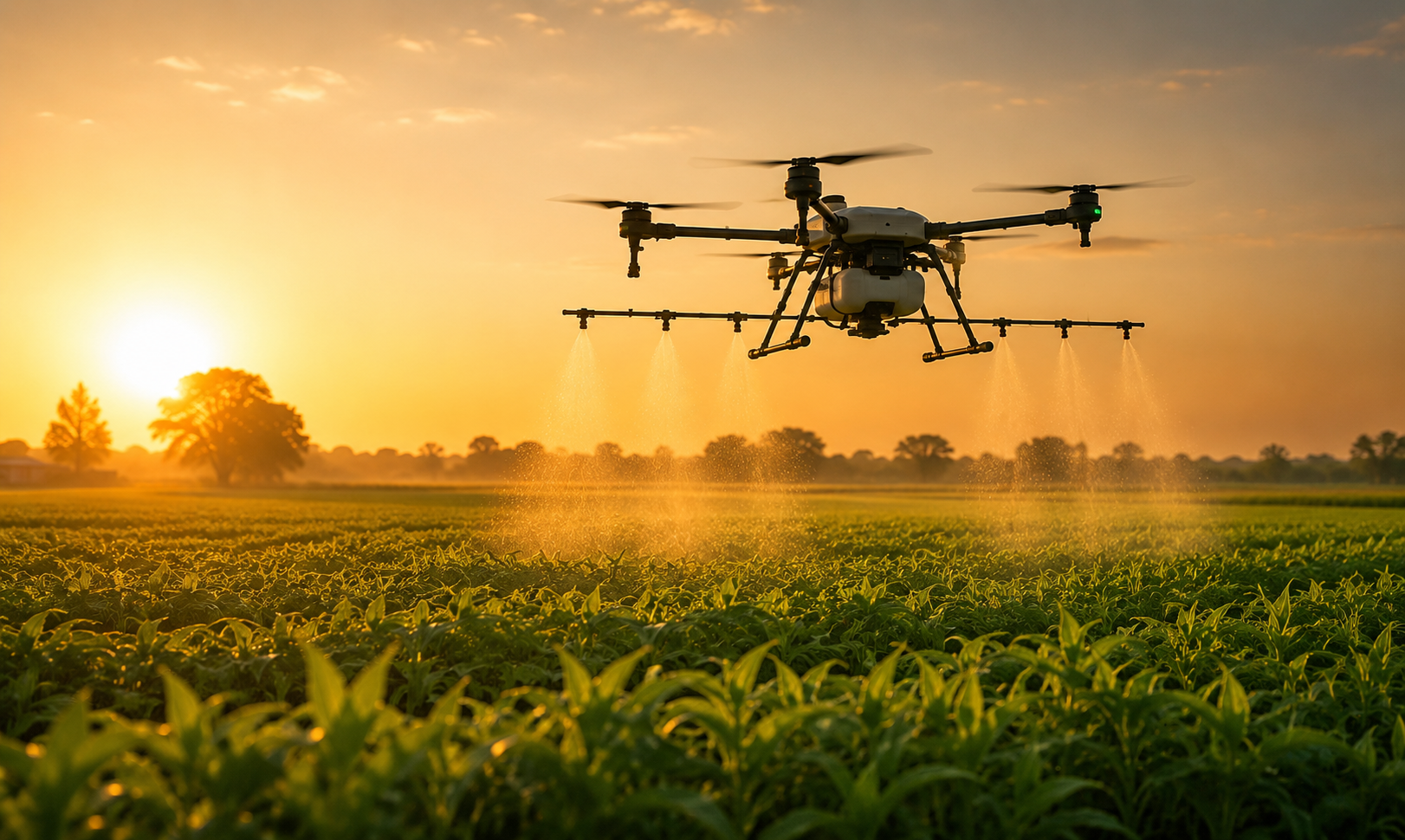
Drones fitted with obstacle sensors and lights can operate at dawn, dusk and night —precisely when wind usually stays below the 10 km/h comfort limit, temperatures are lower so less chemical evaporates before it lands, and honeybees are not foraging. In coastal Andhra Pradesh through April and May, when midday spraying is both punishing for labour and wasteful for chemistry, early-morning drone slots are often the only sensible option on the calendar.
7. Tall and dense crops become practical to spray
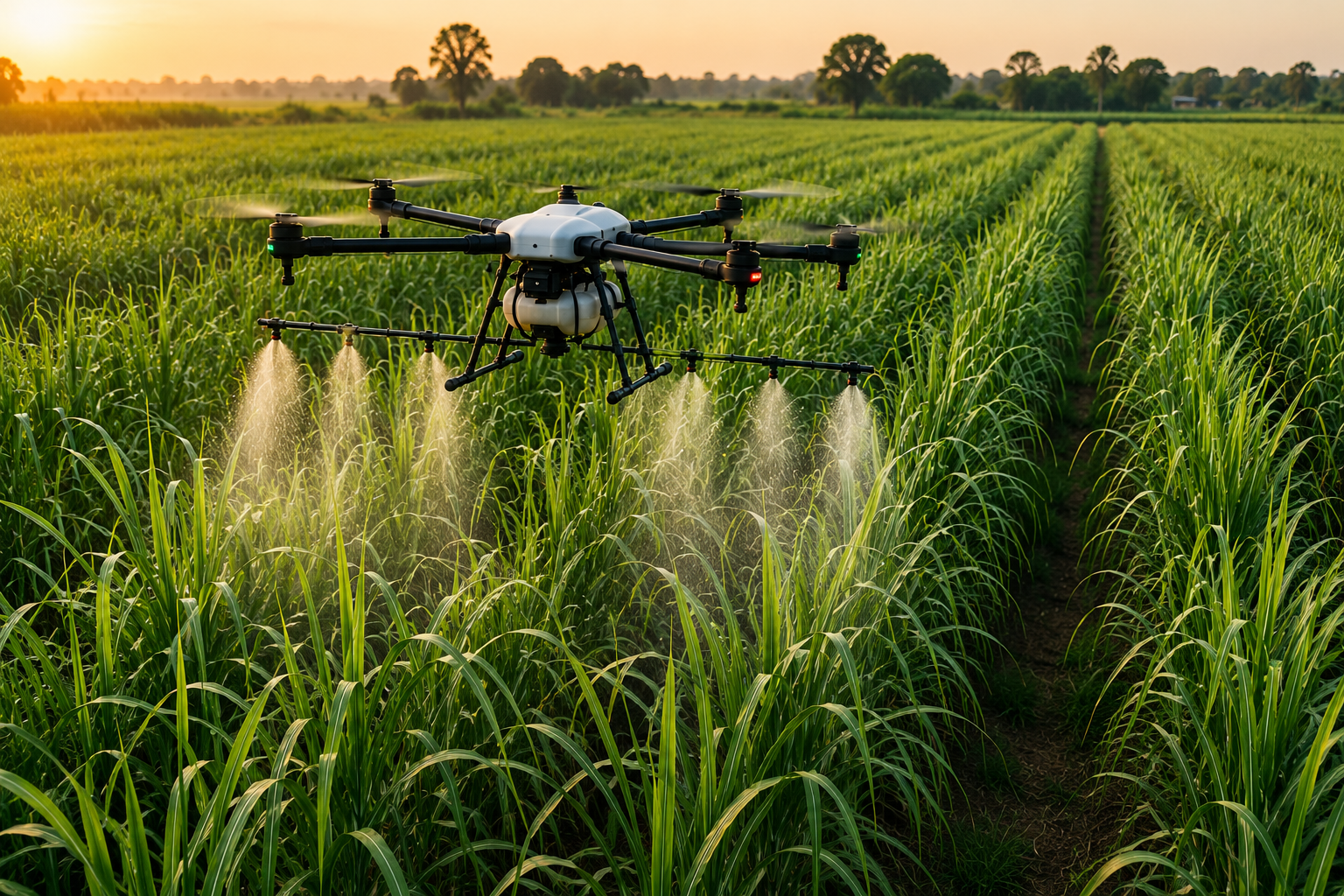
Nobody can walk through 8-10 feet of grown sugarcane, and a tractor cannot enter tasseling maize without destroying rows. Drones treat exactly these crops: top-canopy sprays against woolly aphid in the cane belts from Kolhapur to Mandya, and directed sprays against fall armyworm sheltering in maize whorls. For tall, dense or late-stage crops, a drone is not merely the faster method — it is frequently the only viable application method left.
8. Village-scale and institutional deployment
Pest outbreaks rarely stop at one farm boundary. When a cluster of fields needs treatment, coordinated drone operations can help cover large blocks quickly and consistently. Ethereal Flights’ Drone-as-a-Service model is designed for exactly this kind of scalable deployment — supporting agriculture campaigns, institutional programs, agri-input companies and local service networks without requiring every farmer to own a drone.
9. Less waste, better input discipline
Drone spraying encourages measured, map-based application rather than guesswork. By using lower spray volumes, controlled swaths and trained operators, farmers can reduce over-application, improve consistency and limit unnecessary runoff into bunds and irrigation channels. The result is a cleaner, more accountable spray operation — especially valuable where buyers, residue standards and input costs are becoming more demanding.
10. Costs that compete with labour — honestly compared
Drone spraying should be evaluated against the full cost of manual spraying: labour availability, water hauling, time lost, uneven coverage, safety risk and crop trampling. Ethereal Flights’ service-led model helps customers access drone capability without bearing the full burden of ownership, maintenance, batteries, training and compliance.
Which crops benefit most
• Paddy: quick treatment during narrow pest and disease windows, especially in waterlogged or closed-canopy fields.
• Cotton and chilli: faster response to pest pressure with more uniform coverage across large plots.
• Maize and sugarcane: practical spraying where crop height makes manual or tractor entry di<icult.
• Vegetables and orchards: targeted application where timing, coverage and reduced labour exposure matter most.
The honest limitations
Drone spraying is not a universal answer, and a service that pretends otherwise should worry you. Know these limits before you book:
• Weather still matters: high wind, rain and extreme heat can delay spraying.
• Correct chemistry matters: only approved products and label-compliant doses should be used.
• Pilot skill matters: field mapping, height, speed, swath overlap and droplet settings a<ect results.
• Not every farm needs to buy: ownership makes sense only with enough annual utilisation; many farmers are better served by hiring certified operations.
Government support if you want to own, service economics if you want to hire Government programs have made agricultural drones more accessible for farmers, FPOs, custom hiring centres and women-led groups. Even with subsidy support, ownership requires batteries, maintenance, trained pilots, compliance and enough acres to keep the machine working. For many users, Ethereal Flights’ Drone-as-a-Service approach oLers the better arithmetic: access the technology when needed, scale operations during the season, and avoid idle equipment costs.
Why Ethereal Flights
Ethereal Flights is building an Indian drone ecosystem across manufacturing, pilot training, sales, services and Drone-as-a-Service. Its agriculture solutions support crop monitoring, precision spraying and scalable field operations, while the wider company works across agriculture, surveillance, defence, smart cities and industrial inspection. For farmers and institutions, the promise is straightforward: reliable drone operations, trained pilots, practical service models and precision technology designed to make spraying faster, safer and more eLicient.